E-mail: sales001@bosschemical.com JINAN BOSS CHEM CO.,LTD
Telephone: +86-15628782329

- All
- Product Name
- Product Keyword
- Product Model
- Product Summary
- Product Description
- Multi Field Search
Views: 0 Author: Y Publish Time: 2026-10-19 Origin: Site
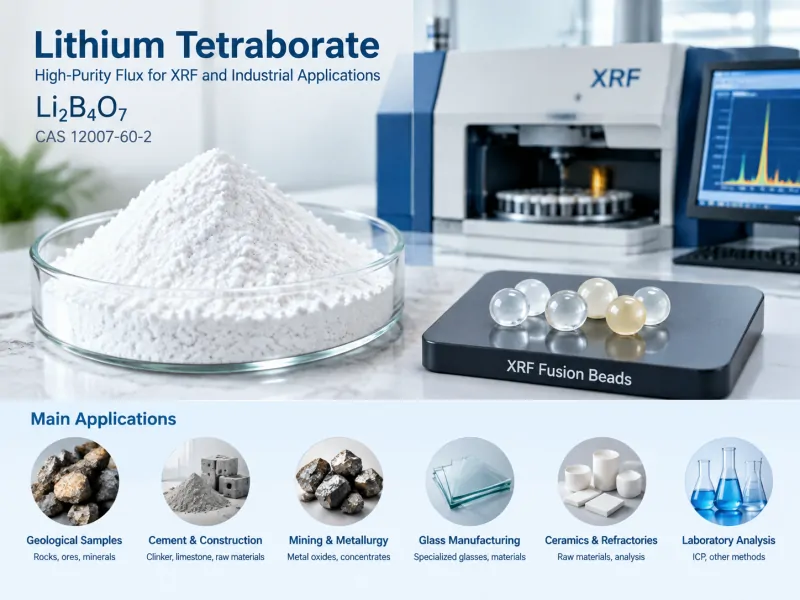
Inorganic lithium borate compound which is used extensively in analytical chemistry, materials science and industrial manufacturing is known as Lithium tetraborate. It is well known as a fusion flux for X-ray fluorescence (XRF) analysis, in which it helps the conversion of solid samples to homogeneous glass beads for accurate elemental analysis.
Chemical formula of Lithium tetraborate is Li2B4O7. It is also known as lithium borate or dilithium tetraborate and is commercially available in different grades of purity depending upon the intended application.
Lithium tetraborate is an important reagent used in laboratories and industrial testing facilities for mineral, cement, glass, ceramic and other inorganic samples for chemical analysis. It is also used in the production of special glasses and ceramic materials.
Property | Description |
Chemical name | Lithium tetraborate |
Molecular formula | Li₂B₄O₇ |
CAS number | 12007-60-2 |
Molecular weight | Approximately 169.11 g/mol |
Appearance | Typically a white powder or solid |
Melting point | Approximately 917–930°C, depending on the reference and measurement conditions |
Chemical classification | Inorganic lithium borate |
Main applications | XRF sample preparation, analytical chemistry, glass and ceramic manufacturing |
Lithium tetraborate has many important industrial and laboratory applications. It is widely used for elemental analysis as a fusion flux . Its properties also lend itself to specialized materials manufacturing .
1. X-Ray Fluorescence (XRF) Analysis
One of the most important applications of lithium tetraborate is the preparation of samples for X-ray fluorescence spectroscopy.
XRF is the most common method to determine the elemental composition of solid materials. However, direct analysis of heterogeneous powders may lead to errors in terms of particle size, mineral structure and sample composition.
This is where lithium tetraborate helps in solving these problems by fusion bead method .
In a typical procedure, a powdered sample is mixed with a suitable amount of lithium tetraborate flux and heated in a high-temperature furnace. The mixture melts and, after controlled cooling, forms a glass bead suitable for XRF measurement.
This process can improve the homogeneity of the sample and minimize some particle-size and mineralogical effects and thus lead to more reproducible elemental analysis.
Common sample types include:
Geological samples, including rocks, ores, and minerals
Cement, limestone, and other construction materials
Glass and ceramic raw materials
Metallurgical oxides and selected inorganic industrial materials
Environmental and industrial mineral samples
The flux-to-sample ratio and fusion conditions must be selected according to the sample matrix and analytical method.
2.Cement and Construction Material Testing
The cement industry relies on accurate chemical analysis to maintain product consistency and manufacturing efficiency.
Lithium tetraborate may be used for the preparation of cement, clinker, limestone and related raw materials for XRF analysis. These tests are usually intended to determine the major oxide components calcium oxide, silicon dioxide, aluminum oxide, and iron oxides.
For example, a cement laboratory may use lithium tetraborate fusion to prepare clinker samples before determining their oxide composition. The results give the quality-control teams a means to monitor raw material variation and to control production specification.
Lithium tetraborate is, therefore, an analytical reagent of choice for cement plants, construction material laboratories, and third-party testing facilities.
3.Mining, Minerals, and Metallurgy
Mining and mineral processing operations require reliable information about the composition of ores, concentrates, and geological materials.
Lithium tetraborate is a fusion-based sample preparation for XRF analysis, often used for samples with high contents of basic oxides or carbonate minerals.
Potential applications include:
Analysis of limestone and dolomite
Testing of magnesite and other magnesium-bearing materials
Characterization of selected metal oxides
Quality control of mineral concentrates and processed ores
Geological exploration and laboratory research
For instance, a mineral testing laboratory can fuse a representative powdered sample with lithium tetraborate to produce a homogeneous bead. The bead can then be analyzed to determine major-element concentrations.
For silica-rich samples lithium metaborate or a mixture of lithium metaborate and lithium tetraborate may be more suitable depending upon the matrix and analytical method.
4.Glass Manufacturing
Lithium tetraborate is also relevant to specialized glass formulations and materials research.
Lithium borates compositions affect glass formation, thermal behavior and other material properties. Systems based on lithium tetraborate can be studied by researchers and manufacturers in the development of technical glasses and in studies of materials based on borates.
The choice of its use in a specific glass formulation depends on the required composition, the processing temperatures, the optical properties, the chemical resistance and the final product specifications.
We have to distinguish between the use of lithium tetraborate as a laboratory fusion flux and the use of lithium tetraborate as a raw material in a finished glass composition. The purity and performance requirements may be very different.
5.Ceramic Materials and Refractory Analysis
Ceramic products and refractory materials often contain complex mixtures of oxides and mineral phases. These components must be measured accurately to ensure consistent quality.
Preparation of selected ceramic and refractory samples for XRF analysis by lithium tetraborate fusion. This gives a glass bead that helps to reduce the heterogeneity of the sample and facilitates elemental analysis.
Typical applications include testing ceramic raw materials, analyzing selected refractory oxides, and supporting quality control in industrial materials laboratories.
Whether lithium tetraborate is the best flux depends on the acidity or basicity of the sample matrix. Lithium metaborate or a mixed flux may offer better performance for certain silicate-rich materials.
6.Laboratory Analytical Chemistry
Beyond XRF fusion, lithium tetraborate is used in specialized analytical procedures that require the dissolution or fusion of inorganic materials.
Depending on the analytical method, it may be used in sample preparation for elemental analysis by techniques such as inductively coupled plasma atomic emission spectroscopy (ICP-AES).
The choice of the fusion method depends on the target elements, the sample composition, possible contamination and the subsequent dissolution technique.
Laboratories should use analytical grade lithium tetraborate and validated procedures to minimize blank values and measurement uncertainty.
Lithium tetraborate is an inorganic compound that can be prepared through controlled reactions involving suitable lithium-containing and boron-containing raw materials.
A general preparation procedure is the reaction of a suitable source of lithium such as lithium carbonate with boric acid or a suitable source of boron oxide at elevated temperature. The composition of the lithium borate is controlled by the reaction conditions.
A simplified reaction using lithium carbonate and boric acid can be represented as:
Li₂CO₃ + 4H₃BO₃ → Li₂B₄O₇ + CO₂ + 6H₂O
Industrial production requires careful control of raw material purity, reaction conditions, thermal treatment, and final product processing. Depending on the intended grade, additional steps may include crushing, milling, sieving, purification, or other treatments to achieve the required product specifications.
Special importance is paid to the control of impurities in analytical grade lithium tetraborate. The material may contain contaminants such as iron, silicon, aluminum, calcium, sodium and other elements which can affect analytical results when used as an XRF flux.
The concrete production process and the demands placed on quality control are dependent on the technology of the manufacturer and the application.
For industrial buyers and laboratory procurement teams, selecting the right lithium tetraborate supplier involves more than comparing prices.
Purity and Impurity Profile
Purity is a key consideration for analytical applications. Buyers should review the assay, relevant metallic impurities, insoluble matter, and other parameters specified in the product documentation.
For XRF applications, even low levels of certain contaminants may influence analytical background or introduce measurement errors.
Product Consistency
Consistent chemical composition, particle characteristics, and moisture levels can help laboratories maintain stable fusion conditions.
If you have ongoing testing requirements, ask if the supplier can deliver consistent quality across production batches.
Technical Documentation
A professional supplier should be able to provide relevant documentation, such as:
Technical data sheet (TDS)
Safety data sheet (SDS)
Certificate of Analysis (COA), where available
Product specifications and packaging details
Batch identification and traceability information
Packaging and International Shipping
Packaging requirements are based on the quantity ordered, product grade, transport conditions, and destination-country regulations.
Bulk buyers should confirm packaging options, storage recommendations, lead time, export documentation, and shipping arrangements before placing an order.
Application Specific Support
A supplier that knows the difference between lithium tetraborate and lithium metaborate can help buyers select a suitable grade for their intended application.
For a quotation please specify purity required, application, order quantity, packaging preference and destination country. Such details help you compare offers on a like-for-like basis.
Lithium tetraborate is an important inorganic compound and has established applications in XRF sample preparation, analytical chemistry and in some glass and ceramic material systems.


